
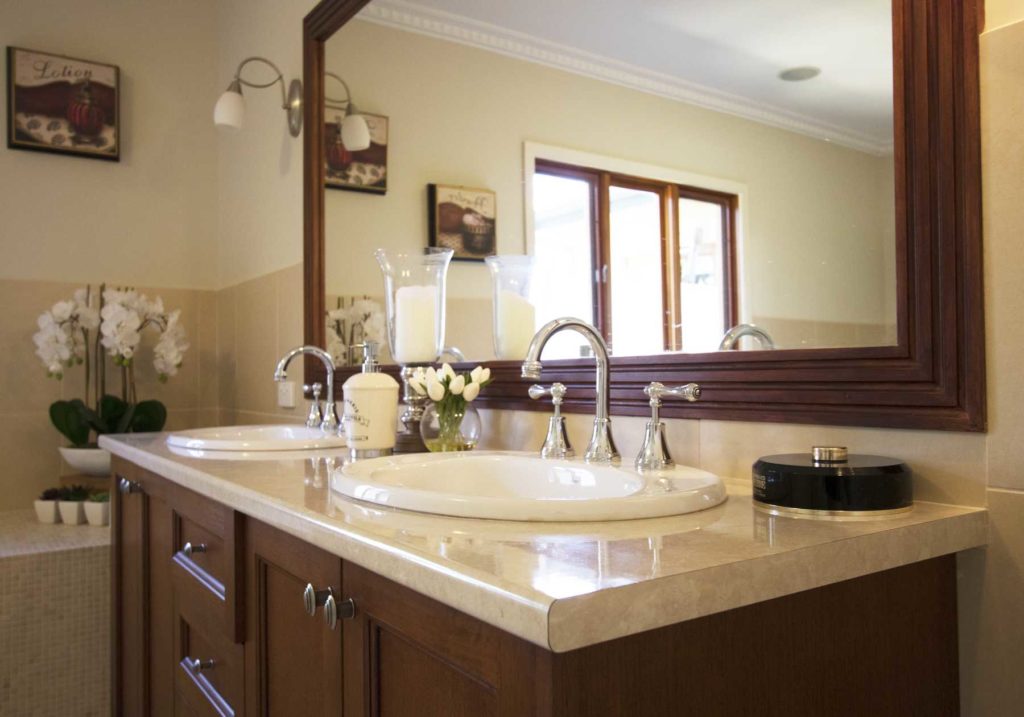
Small bathrooms are one of the most common projects we work on, and consistently one of the most rewarding to get right. The conversation usually begins in the same place: a homeowner who has lived with a bathroom that feels cramped, cluttered, or simply joyless, and who has spent considerable time on Pinterest looking for the trick that will fix it. The truth is that there is no trick. What transforms a small bathroom is the same thing that transforms any room: decisions made with genuine care for proportion, light, material, and the specific character of the space. Working with an experienced Melbourne Bathroom Designer is less about finding clever solutions and more about asking the right questions before reaching for the tile samples.
Why small bathrooms are harder to design than large ones
There is a common assumption that small spaces are easier to design because there is less to consider. The opposite is true. In a large bathroom, mistakes in proportion or material selection can be absorbed by the scale of the room. In a small one, every decision is visible, every choice compounds the others, and there is nowhere for an error to hide.
This is what makes the small bathroom such a rewarding design exercise when it is done well, and such a frustrating one when it is not. A small bathroom designed with genuine care for the relationships between its elements, tile format, fixture scale, vanity proportion, lighting quality, can feel calm, complete, and considerably more spacious than its physical dimensions suggest. One designed without that care feels cramped regardless of its actual size.
The difference almost always comes down to specificity. Generic advice applied to a specific room rarely produces the best result. The decisions that make a small bathroom in a Victorian terrace in Fitzroy feel resolved are not necessarily the same ones that work in a compact ensuite in a contemporary apartment in South Yarra. The room, its proportions, its light, its relationship to the rest of the home, all of these need to inform the design rather than a set of rules applied from outside it.
Proportion before everything else
Before any material or finish decision is made, the proportional relationships within the bathroom need to be considered. Where the vanity sits in relation to the room. How the shower is positioned relative to the door and the window. Whether a freestanding bath, if there is one, has enough space around it to read as an intentional object rather than something squeezed in. Whether the ceiling height is being used or ignored.
These are questions that precede tile selection, tapware choice, and colour palette, and they are the questions that most directly determine whether the finished room feels spacious or constrained. A small bathroom with excellent proportional decisions and modest finishes will almost always feel better to be in than one with beautiful finishes and poor proportional thinking.
Ceiling height is particularly underused in small bathrooms. Taking wall tiles to the full ceiling height, or using a ceiling-mounted shower head that draws the eye upward, both create a vertical emphasis that counteracts the sense of compression that a small room can produce. The room does not become larger, but the experience of being in it shifts.
Tile format and how it reads in a small space
Large format tiles
Smaller format tiles
The grout question
The vanity and its relationship to the room
The vanity is the piece of furniture around which the bathroom organises itself, and its scale, profile, and finish have more influence on how the room reads than almost any other single element. In a small bathroom, the vanity decision is particularly consequential.
A wall-hung vanity, mounted above the floor rather than sitting on it, creates a visual gap between the cabinetry and the floor that makes the room feel more open. The floor reads as a continuous surface rather than one interrupted by a vanity plinth, and the eye travels further before it meets an obstacle. This is one of the few genuinely consistent pieces of advice for small bathrooms: if the wall structure allows it and the plumbing can be accommodated, a wall-hung vanity almost always makes the room feel more spacious than a floor-standing one of the same size.
Vanity depth is another consideration that is often overlooked. A standard vanity runs at around 450 to 500 millimetres deep, but in a bathroom where floor space is at a premium, a shallower option at 350 to 400 millimetres can return meaningful circulation space without sacrificing the storage that the vanity provides. These are small numbers that make a larger difference to the experience of the room than they suggest on paper.
The finish of the vanity, whether painted timber, natural oak, a lacquered surface, or a more graphic laminate, contributes to the overall material story of the room. In a small bathroom, a vanity that is tonally consistent with the wall and floor palette creates a quieter, more continuous reading. One that contrasts sharply with its surroundings draws attention to itself and, by extension, to its size. Neither is wrong as a choice, but the implications of each need to be understood before committing.
Mirrors and the quality of reflected light
The mirror is one of the most powerful tools available in a small bathroom, not because it creates an illusion of space, though it can, but because of what it does to the quality and quantity of light in the room. A well-positioned mirror opposite or adjacent to a window reflects natural light back into the space and distributes it in a way that makes the room feel brighter, warmer, and more alive.
Scale matters here. A mirror that is too small for its wall reads as timid and makes the wall behind it feel larger by contrast, which is rarely the desired effect. A mirror that runs the full width of the vanity, or that extends to the ceiling from the benchtop, creates a surface that is both functional and architectural, giving the wall it occupies a purpose and presence that a smaller mirror cannot achieve.
Frame choice is a detail that earns its consideration. A frameless mirror reads quietly and works with almost any palette. A mirror with a considered frame, in timber, in stone, in an unlacquered metal, introduces a material note into the room and gives the wall it hangs on more presence. In a small bathroom where every surface is visible simultaneously, these details register in a way they might not in a larger room.
Lighting and the difference it makes
Bathroom lighting in most homes is treated as a functional necessity rather than a design consideration, and the results reflect that. A single downlight above the shower and a shaving light above the mirror are the standard approach, and the standard approach produces a bathroom that is adequately lit and visually flat.
The quality of light in a small bathroom has an outsized effect on the experience of being in it. Harsh, cool-toned overhead light makes every surface feel clinical and every imperfection more visible. Warm, layered light, with some ambient softness alongside the task lighting, transforms the room into something that feels genuinely pleasant to spend time in. This matters in a bathroom more than in most rooms because bathrooms are used at both ends of the day, at the moments when the quality of the environment has the most influence on mood.
Backlit mirrors and illuminated mirror cabinets are worth considering in small bathrooms where the ceiling height limits what can be achieved with downlighting alone. The light source being at face height rather than above creates a more flattering, more even illumination of the room and avoids the heavy shadowing that overhead-only lighting tends to produce. Dimming capability, even in a bathroom, makes a considerable difference to the versatility of the space across different times of day.
Colour and the small bathroom
The default advice for small bathrooms is to keep everything white or very light, on the basis that pale colours reflect more light and make rooms feel larger. This is not wrong, but it is incomplete, and following it uncritically produces bathrooms that feel safe rather than considered.
Dark or deeply toned bathrooms can feel dramatically good in small spaces, provided the light is handled well. A bathroom tiled in a deep forest green or a warm charcoal, with considered lighting and a mirror that reflects natural light back into the room, can feel intimate and enveloping in a way that is entirely intentional and entirely successful. The darkness does not make the room feel smaller. It makes it feel purposeful.
The more reliable principle than light versus dark is tonal consistency. A bathroom where the walls, floor, and joinery read in a close tonal relationship, whether that relationship is at the pale or the dark end of the spectrum, creates a visual continuity that allows the eye to travel through the space without interruption. It is the interruptions, the sharp contrast between floor and wall, between vanity and tile, between fixture and surface, that most often make small rooms feel fragmented and therefore smaller.
Fixtures and the case for restraint
Fixture selection in a small bathroom is an exercise in restraint. Every element that is added to a small room increases the visual complexity of the space, and there is a point beyond which that complexity begins to work against the sense of calm that makes a bathroom feel good to be in.
Tapware finish is a decision that deserves more deliberation than it typically receives. A consistent finish across all tapware, the shower, the basin tap, the towel rail, and any other fittings, creates a cohesive material story. Mixed finishes can work, but they require more confidence and more precision than most homeowners realise, and in a small bathroom where every detail is immediately legible, an inconsistent approach to finish tends to feel unresolved rather than curated.
Basin selection is similarly consequential. A vessel basin sitting above the benchtop adds height and visual interest but also adds visual mass. An undermount or inset basin keeps the benchtop reading as a continuous surface, which tends to feel calmer. A wall-hung basin with no cabinetry below maximises the sense of floor space but eliminates storage. Each of these is a legitimate choice with real implications for how the room reads and functions, and each deserves to be made deliberately rather than by default.
Storage and the visible versus the concealed
Storage in a small bathroom is one of the most practically important design considerations and one of the most visually consequential. A bathroom with insufficient storage does not simply inconvenience the household that uses it. It creates a visual accumulation of objects on surfaces that undermines every other design decision in the room.
The most effective approach in a small bathroom is to resolve as much storage as possible within the architecture of the room, within the vanity, within a recessed niche in the shower, within a mirror cabinet that replaces a standard mirror, so that the surfaces remain clear and the room reads as intentional rather than crowded. A recessed niche in the shower, tiled to match the surrounding wall, disappears into the room rather than projecting from it, and provides the functional shelf space that every shower requires without adding any visual bulk.
Open shelving can work in a small bathroom when it is curated carefully and maintained consistently. A single shelf holding a small number of objects in a considered arrangement adds warmth and personality to the room. Multiple shelves holding the accumulated reality of a household’s bathroom life create the kind of visual clutter that makes a small space feel chaotic rather than calm. The decision about what to put on open shelves, and what to conceal behind doors, is as much a design decision as any material choice.
What Melbourne bathrooms tend to need most
Melbourne homes span an extraordinary range of architectural types, from the compact ensuites of Victorian terraces in the inner suburbs to the bathrooms of mid-century homes in the eastern suburbs to the larger, more generous wet rooms of contemporary builds. Each of these contexts presents different challenges and different opportunities, and the design approach that serves one well may not be the right starting point for another.
What most Melbourne bathrooms share, regardless of their architectural context, is a relationship with natural light that needs to be actively considered. Melbourne’s light is particular, with a quality in winter that is quite different from the warmth of summer, and bathrooms that are designed only for the best-case light condition tend to feel dull and cold for a significant portion of the year. Designing for the full range of light conditions the room will experience, through material choices, mirror placement, and layered artificial lighting, produces a bathroom that feels good year-round rather than only on bright mornings.
The inner suburban bathroom, in particular, is often a room that has been modified multiple times over the life of a period home, with decisions from different eras sitting uncomfortably alongside each other. Bringing coherence to a room like this, identifying what is worth keeping and what needs to change to allow the room to read as a whole, is one of the most satisfying design exercises available, and one where an experienced eye makes the most consistent difference.
Working with Jane Gorman Decorators on a bathroom
The studio works with homeowners across Melbourne on bathrooms of every size, from compact ensuites to principal bathrooms being renovated as part of a broader home project. The approach is the same regardless of scale: understand the room, understand the household, and make the decisions that will have the most meaningful impact on the experience of being in the space every day.
For small bathrooms in particular, the value of working with a designer is not in the ideas themselves, many of which homeowners will have encountered in some form already. It is in the judgment about which ideas are right for the specific room and which, however appealing in isolation, will not serve it. That judgment comes from having made these decisions across many different rooms and having seen what works and what does not in practice.
If you are planning a bathroom renovation or simply trying to understand what would make the most difference to a bathroom that has never quite felt right, we would love to hear from you.
Frequently asked questions
What makes the biggest difference in a small bathroom?
Should I use dark or light colours in a small bathroom?
Is a wall-hung vanity always better in a small bathroom?
How important is grout colour in a small bathroom?
What should I prioritise if I have a limited budget for a small bathroom update?
A small bathroom does not have to feel like a concession. Designed with genuine care for proportion, light, material coherence, and the specific character of the room it sits within, a compact bathroom can be one of the most considered and enjoyable spaces in a Melbourne home. Jane Gorman Decorators works with homeowners across the city to find the decisions that make the most meaningful difference, whether that means a full renovation or a more focused redesign. To discuss your bathroom or book a consultation with the studio, get in touch today.