
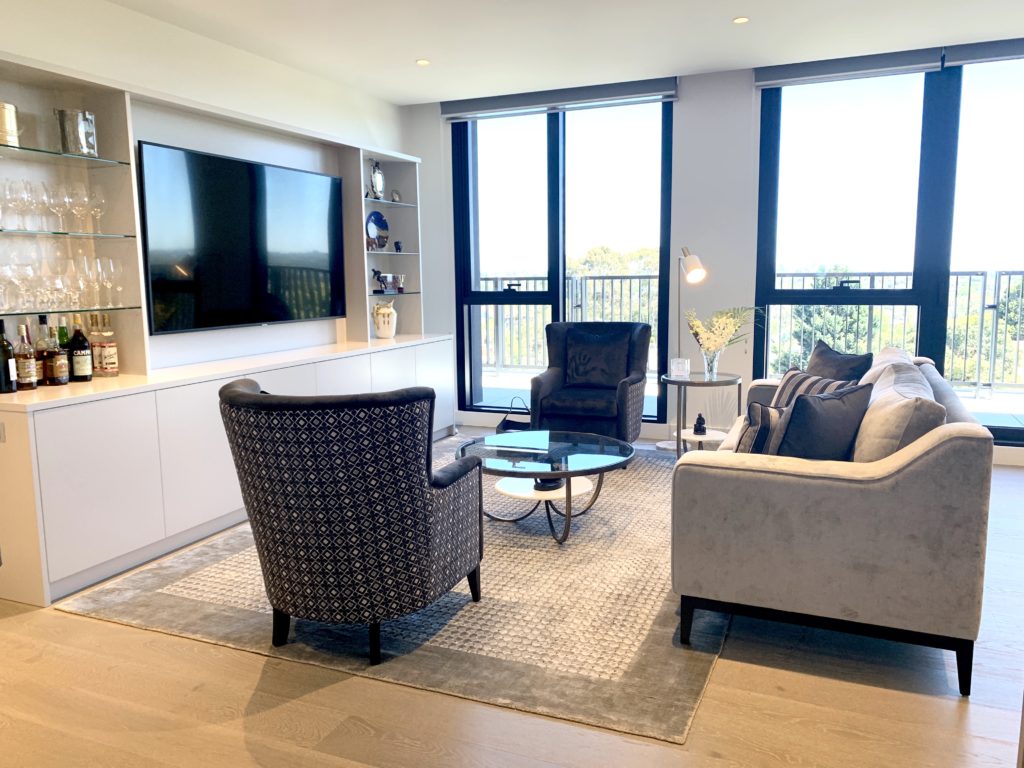
Apartments present a particular kind of design challenge. The constraints are real: limited floor area, fixed structural elements, building regulations that govern what can and cannot be changed, and a developer-grade finish that is rarely the starting point anyone would choose. And yet some apartments feel genuinely beautiful to live in, with a quality of considered warmth and personal expression that makes their footprint feel entirely beside the point. The difference almost always comes down to design thinking applied specifically to the apartment rather than borrowed from the world of houses. At Jane Gorman Decorators, we work with apartment owners across the city who are trying to close that gap, and the patterns in what works and what does not are consistent enough to be worth exploring in some depth.
Why apartment design is its own discipline
The most common mistake in apartment design is treating the space as a smaller version of a house and applying the same design logic at reduced scale. This produces apartments that feel cramped rather than intimate, cluttered rather than layered, and visually busy in a way that the same decisions in a larger space would not create. An apartment has different proportional relationships, different light conditions, different acoustic qualities, and different functional pressures than a house, and the design needs to respond to those differences rather than ignore them.
The starting point for good apartment design is an honest assessment of what the space actually is: its proportions, its light, the quality of its fixed elements, the degree to which those elements can be changed, and the functional demands the household places on it. From that assessment, a design can be developed that is specific to the apartment rather than generic, and that specificity is what produces spaces that feel resolved rather than decorated.
Melbourne’s apartment stock is extraordinarily varied, from the high-ceilinged, generously proportioned apartments of converted warehouse buildings in Fitzroy and Collingwood to the compact, developer-finished apartments of newer towers across the CBD and inner suburbs. Each of these contexts requires a different design response, and the advice that serves one well may actively harm another. What they share is the need for design thinking that starts with the specific conditions of the space rather than with a generic vision applied from outside it.
What developer finishes do to a space and how to work with them
Most Melbourne apartments come with a version of the same developer finish: stone-look laminate benchtops, engineered timber flooring in a mid-tone grey-brown, white walls, stainless steel appliances, and pendant fittings of no particular character. These finishes are not chosen for their design quality. They are chosen for their cost, their durability, and their inoffensiveness to the broadest possible range of buyers. They are also, collectively, one of the most significant design challenges an apartment occupant faces, because they create a visual environment that is difficult to make feel personal or warm without either replacing them or making enough deliberate design decisions around them to shift the overall character of the space.
Replacing developer finishes entirely is sometimes the right decision and sometimes not, depending on the budget, the lease situation, and the quality of what is already there. For owner-occupiers with the budget and the intention to stay, replacing the benchtop, the flooring, or the kitchen cabinetry can transform the space in ways that no amount of styling can replicate. For renters, or for owners who want to improve the space without a full renovation, the challenge is making better decisions around and on top of what is already there.
The most effective approach for working with a developer finish rather than against it is to identify the one or two elements that are most visually dominant and address those first. In most apartments, the flooring is the single largest surface in the space, and it has a disproportionate effect on the overall character of the room. A rug of the right scale and quality can fundamentally shift how the floor reads and by extension how the room feels, at a fraction of the cost of replacing the floor itself. After the floor, the window treatment is usually the most impactful element to address, because developer blinds tend to be cheap, poorly proportioned, and entirely at odds with any design intention the occupant brings to the space.
Scale and the apartment proportions problem
Scale is the design consideration that is most consistently mishandled in apartments, and the one whose mishandling most reliably produces spaces that feel uncomfortable rather than intimate. The instinct when designing a small space is often to use small-scale furniture, on the basis that smaller pieces will make the space feel less crowded. This instinct is almost always wrong.
Small furniture in a small space does not make the space feel larger. It makes it feel cluttered and provisional, as though the apartment is furnished with things that were chosen to fit rather than to belong. The furniture that tends to work best in apartments is furniture of appropriate quality and considered scale, pieces that are sized correctly for the room they are in rather than sized down from what would be used in a house. A generous sofa in an apartment living area reads as a decision. A small sofa surrounded by small tables and small lighting reads as an accumulation.
The sofa as the critical decision
Dining in an apartment
Dining tables in apartments are a frequent source of scale error in both directions. A table that is too small for the household’s actual dining needs produces a room that always feels slightly inadequate for the occasions it needs to serve. One that is too large dominates the room and makes daily circulation feel effortful. The right size is determined by the household’s actual dining habits and the genuine dimensions of the space available, not by a desire to have a table that looks generous in photographs. An extendable table is often the most honest solution for an apartment household that entertains occasionally but dines simply on most evenings.
Light in apartments: the fixed and the flexible
Maximising and managing natural light
Window treatments in apartments serve two functions that are sometimes in tension: maximising the quality of daylight that enters the space, and providing privacy and light control when needed. Developer blinds typically fail at both. A sheer curtain in a fine linen or voile, hung from a ceiling-fixed track at the full height of the window rather than from just above the window frame, does something quite different: it filters light into the room with warmth and softness, makes the window appear taller and more generous than it is, and creates a quality of diffuse daylight that makes the apartment feel brighter without the harshness of direct sun.
For rooms that receive no direct natural light, or that face a less desirable aspect, the design challenge is to create a sense of warmth and brightness through the palette and the materials rather than through the light itself. Warm-toned neutrals that read well under artificial light, reflective surfaces placed to bounce available light around the room, mirrors positioned to multiply the sense of space and light: these are the tools available, and they require more considered application in a light-limited apartment than in a house where natural light can be relied upon.
Artificial light and the apartment atmosphere
Storage and the apartment's hidden pressure
Storage is the constraint that most directly determines whether an apartment feels liveable or pressured, and it is the one that most often goes unaddressed until it has already become a problem. An apartment without adequate, well-organised storage does not simply inconvenience its occupants. It creates a visual accumulation of objects on every available surface that undermines every other design decision in the space and makes the apartment feel smaller and more chaotic than it actually is.
The most effective approach is to resolve storage within the architecture of the apartment wherever possible, through built-in joinery, fitted wardrobes, and storage concealed within furniture rather than added on top of it. A television unit with enclosed storage below resolves a significant proportion of the living room’s storage needs while keeping the floor surface visible and the room feeling open. A bed with integrated drawer storage underneath addresses the bedroom’s storage pressure without adding any furniture to the floor plan. A hallway wall fitted with shallow joinery from floor to ceiling provides storage for coats, shoes, and the accumulated objects of daily life without encroaching meaningfully on the floor area of the space.
What does not work in apartments is storage that is visible and unresolved: open shelving used as a repository for things that have nowhere else to go, surfaces covered in objects that would prefer to be in a drawer, furniture chosen for its appearance with no consideration of its storage contribution. The discipline of designing storage deliberately, before rather than after the furniture is selected, is one of the most consistently effective things an apartment occupant can do to improve the quality of their space.
Colour in apartments: the risks of going too safe
The default colour palette in most Melbourne apartments is white walls with warm timber flooring, and the reason is understandable: it is safe, it photographs well, and it appeals to the broadest possible range of buyers. It is also, in most cases, a missed opportunity. White walls in an apartment do not automatically make the space feel larger or more light-filled. In a room that receives good natural light, they can feel bright and clean. In one that does not, they can feel flat, cold, and slightly institutional.
The apartments that feel most genuinely beautiful to live in are almost never the ones that defaulted to white throughout. They are the ones where a considered colour decision was made, a warm plaster tone in the living area, a deeper, more enveloping shade in the bedroom, a kitchen joinery colour that gives the open-plan space a point of visual interest without competing with everything around it. Colour in an apartment does not make the space smaller. Applied with awareness of the light and the proportions of the room, it makes it feel more deliberate, more personal, and more resolved.
The most reliable approach to apartment colour is to identify the palette that will feel right at the times of day the apartment is most used and in the light conditions it most frequently has. A palette chosen for how the apartment looks on a bright weekend morning may not serve it as well on a weekday evening under artificial light, and most apartment occupants spend more time in the latter condition than the former.
Open plan living and the zone problem
The majority of Melbourne apartments built in the past two decades use an open-plan arrangement for the living, dining, and kitchen areas. This is a spatial format with genuine advantages in terms of flexibility and the sense of openness it creates, and genuine challenges in terms of acoustic quality, the difficulty of creating distinct zones within a continuous space, and the way that cooking smells and sounds from the kitchen pervade the living area in a way that a separated kitchen does not allow.
The design challenge in an open-plan apartment is to create a sense of differentiation between zones without dividing the space physically. Rugs are the most effective tool available for this: a rug that defines the living area creates a visual boundary between the seating zone and the dining zone without any physical interruption of the floor plane. Lighting that is specific to each zone, a pendant over the dining table, floor lamps in the living area, under-cabinet lighting in the kitchen, creates a similar differentiation that becomes particularly legible in the evening when each zone can be lit independently.
Furniture arrangement is the third tool for zone definition in an open-plan apartment. A sofa placed with its back to the dining area creates a soft visual separation between the two zones. A console table behind the sofa performs the same function while adding a surface that neither zone provides on its own. These are simple spatial decisions with a significant effect on how the apartment feels to move through and to be in, and they are available to any occupant regardless of whether structural changes are possible.
What genuinely does not work in apartments
Some design decisions that work well in houses consistently fail in apartments, and it is worth being direct about them. Oversized artwork, scaled for a gallery wall in a generous house, can dominate an apartment wall in a way that makes the room feel smaller rather than more considered. Feature walls in high-contrast colours or bold patterns can work in a room with sufficient depth to absorb them and tend to feel oppressive in a room without it. Freestanding bookshelves loaded with objects create visual complexity that a small space struggles to resolve.
Pattern, used without restraint, is one of the most reliable sources of visual restlessness in an apartment. A patterned rug in an otherwise calm room can be beautiful. A patterned rug beneath patterned cushions on a sofa beside patterned curtains creates a visual competition that the apartment cannot win. The most successful apartments tend to be those where pattern is used sparingly and deliberately, as a single considered note in a palette that is otherwise tonal and calm.
The other thing that consistently does not work in apartments is trying to replicate the specific qualities of a house in a space that is not one. An apartment with a dining table for ten, a separate study, and a full sofa suite is not a small house. It is an apartment that has been furnished for a different life than the one it is actually required to support. The apartments that feel most genuinely liveable are those designed around how the household actually uses the space rather than around an idea of how a larger home would be furnished.
Working with Jane Gorman Decorators on an apartment
The studio works with apartment dwellers at every stage of the design process, from those moving into a new apartment who want to get it right from the beginning to those who have lived with a space that has never felt quite resolved and want to understand what to change. The approach is the same in both cases: start with the specific conditions of the apartment, understand how the household actually uses it, and make the design decisions that serve both.
For clients working within the constraints of a rental or a developer finish, the conversation is about identifying the highest-impact changes available within those constraints and making them with as much intentionality as a full renovation would receive. For those with the scope to renovate, it is about using that scope wisely, prioritising the decisions that will make the most meaningful difference to daily life rather than those that are simply most visible in the brief.
If your apartment has never felt quite like a home, or if it has always felt smaller and less resolved than you hoped, we would be glad to talk about what the specific space needs and how the studio might help.
Frequently asked questions
How do I make an apartment feel more spacious without structural changes?
Can an apartment feel as personal and warm as a house?
What should I prioritise when designing an apartment on a limited budget?
How do I deal with a developer kitchen that I cannot afford to replace?
Is it worth hiring an interior designer for an apartment?
An apartment designed with genuine care for its specific conditions, its light, its proportions, and the life that takes place within it, can be one of the most satisfying homes to live in. The constraints are real, but so is the potential. Jane Gorman Decorators works with apartment dwellers to find the design decisions that make that potential legible. To discuss your apartment or book a consultation with the studio, get in touch today.