
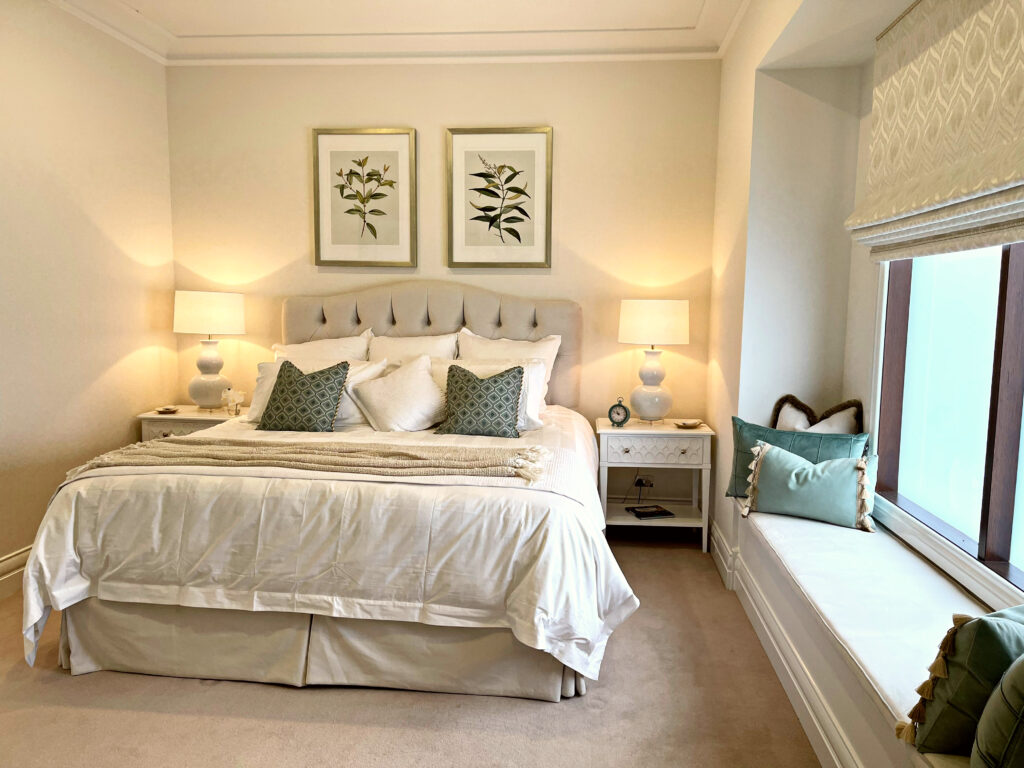
Interior design conversations about bedrooms tend to focus on how the room looks: the palette, the bedhead, the layering of textiles, the quality of the morning light. These things matter, and getting them right is part of what the team at Jane Gorman Decorators spend a great deal of time thinking about. But there is a dimension of bedroom design that receives far less attention than it deserves, which is whether the room has been designed to actively support sleep, not just to look beautiful while sleep happens in it. A bedroom that does the former as well as the latter is a meaningfully different room from one that does only the latter, and the difference is felt every single night.
Why the bedroom deserves a different kind of design thinking
Every room in a home has a primary purpose, and the design should serve that purpose before it serves any other. The kitchen is designed to support cooking. The living room is designed to support gathering and relaxation. The bedroom is designed to support sleep, and the quality of that sleep has consequences for every waking hour of the day in a way that the quality of cooking or relaxation does not quite match.
Sleep science has developed considerably in the past two decades, and what it has established about the conditions that support and undermine sleep is directly relevant to how a bedroom is designed. Light, temperature, sound, the degree of visual complexity in the room, the materials in contact with the body during sleep: all of these have measurable effects on sleep quality, and all of them are, to varying degrees, design decisions. A bedroom designed with awareness of these factors will consistently produce better sleep than one designed without it, even if both rooms are equally beautiful.
This does not mean that bedroom design becomes clinical or that the pursuit of sleep quality requires sacrificing aesthetics. The decisions that support sleep and the decisions that produce a beautiful, restful room are, in almost every case, the same decisions. They simply need to be made consciously rather than by default.
Light: the most powerful design lever for sleep
Controlling natural light
The control of natural light in a bedroom is one of the most practically important and most frequently underinvested design decisions. Curtains or blinds that do not adequately exclude morning light create a room that is difficult to sleep in during summer months, when dawn arrives early, and that makes the final hours of sleep in the morning lighter and more fragmented than they need to be. This matters most for anyone who sleeps later than sunrise or who is sensitive to light during sleep.
The solution is not necessarily blackout, though full blackout is genuinely valuable for light sleepers and for households where adults and children have different wake times. A well-lined curtain in a fabric with sufficient density to reduce rather than eliminate morning light is often sufficient, and it allows the room to receive the quality of daylight that contributes so much to how it feels during waking hours. The decision should be made based on the room’s orientation and the household’s sensitivity to light rather than on a general rule.
Artificial light in the evening
The artificial lighting in a bedroom in the hours before sleep should be warm, dim, and controllable. This means a colour temperature closer to 2700 Kelvin than to 4000, a light level that can be reduced significantly below its daytime setting, and a separation between the overhead circuit and the bedside circuit so that the bed area can be lit independently of the rest of the room.
Bedside lamps are the most important light source in the bedroom for sleep purposes, and their quality matters in ways that go beyond aesthetics. A lamp with a bulb that is too bright, too cool-toned, or positioned at a height that directs light directly into the eyes rather than softly across the room undermines the winding-down process that the body needs in the hour before sleep. Choosing a lamp that is warm, soft, and positioned correctly is a design decision with a measurable effect on the quality of sleep that follows.
Temperature and the materials that affect it
Core body temperature needs to fall slightly for sleep to initiate and deepen. A bedroom that is too warm disrupts this process and produces sleep that is lighter, more fragmented, and less restorative than sleep in a cooler environment. The ideal bedroom temperature for most adults sits between 16 and 19 degrees Celsius, which is cooler than most people keep their living areas and cooler than many bedrooms are in the warmer months.
This has implications for bedroom design that are rarely discussed in an interior design context. The choice of bedding materials, the insulating properties of curtains and floor coverings, the ventilation provided by windows or a fan, the thermal mass of the room’s surfaces: all of these influence the temperature the room reaches and maintains through the night, and all of them are amenable to design decisions.
Bedding materials and breathability
Floor materials and bare feet
Sound and the acoustic quality of the room
Sound is the sleep disruptor that bedroom design most consistently fails to address. Most bedrooms are designed as though the acoustic environment is fixed and outside the scope of design decisions, when in fact the materials and furnishings in a room have a significant influence on both the transmission of sound from outside and the quality of sound within the room itself.
Hard surfaces reflect sound. Soft surfaces absorb it. A bedroom with timber floors, plaster walls, a minimal window treatment, and little soft furnishing is an acoustically live room, one in which sounds carry further, reverberate longer, and intrude more readily from adjacent spaces than a room furnished with a deep pile rug, heavy curtains, upholstered furniture, and textile wall treatments. This distinction is felt most acutely during sleep, when the threshold for sound disturbance is lower than at any other time of day.
The acoustic benefits of good textile choices in a bedroom are not incidental. They are a genuine reason to invest in curtains with substantial lining, a rug that extends well beyond the perimeter of the bed, and upholstered furniture that absorbs rather than reflects the ambient sound of the room. These decisions serve the aesthetics of the room and its acoustic quality simultaneously, which is one of the more satisfying examples of function and beauty working in the same direction.
Visual complexity and the resting mind
The brain continues to process visual information even after the eyes are closed, and the quality of the last visual environment it experienced before sleep influences how readily it settles. A room with high visual complexity, many competing focal points, busy patterns, stimulating artwork, and surfaces covered in objects, keeps the mind more active during the transition to sleep than a room that is visually calm and resolved.
This is one of the clearest connections between good interior design and good sleep. The same principles that produce a room that feels restful to be in, a clear visual hierarchy, a palette without excessive contrast, surfaces that are ordered rather than cluttered, furniture that belongs together, are also the principles that produce a room the mind can leave more easily at the end of the day. Designing for visual calm is designing for sleep, whether or not that connection is made explicit.
Artwork in the bedroom deserves particular thought in this context. A piece that is loved but that is visually demanding, with strong contrast, complex composition, or imagery that provokes thought or emotion, belongs somewhere else in the home. The bedroom is the one room where the quality of what the art does to the viewer matters more than what it says about their taste. Soft, tonal, abstract, or quietly naturalistic work tends to serve the bedroom better than pieces that command attention, because the bedroom is a room from which attention needs to be released rather than engaged.
The technology question
Screens in the bedroom are one of the most well-documented contributors to poor sleep, and one of the most consistently present features of the modern bedroom. The blue-spectrum light emitted by phones, tablets, and televisions suppresses melatonin in the same way that natural daylight does, signalling to the body that it is daytime and that sleep should be deferred. The cognitive stimulation of screens, the engagement with content, communication, and information, keeps the mind active at the time it most needs to be winding down.
The design response to this is worth taking seriously. A bedroom designed without a television, with charging points for phones located outside the sleeping area rather than beside the bed, and with no desk or work surface within the room, creates an environment in which the association between the bedroom and sleep is strong and clear. The bedroom becomes a room the brain associates with rest rather than activity, and that association has a genuine effect on how readily sleep comes.
This is not a counsel of perfection. Most households will continue to have phones in the bedroom and many will have televisions. But the design of the room can work with these realities rather than simply accommodating them. A television that can be concealed behind cabinetry when not in use, charging points positioned away from the bed, and a physical boundary between the sleep zone and any desk or work surface all reduce the degree to which the room’s technology competes with its primary function.
The bed itself
Positioning and orientation
Bedhead scale and its effect on the room
Linen layering
Scent and the overlooked sense
Scent is the sensory dimension of bedroom design that receives the least attention and that has one of the most direct effects on how the room feels to be in. The olfactory system has an unusually direct connection to the parts of the brain associated with memory, emotion, and the regulation of arousal, which means that scent in a bedroom can actively support or undermine the transition to sleep in ways that visual and acoustic stimuli do not quite replicate.
This does not require elaborate intervention. A bedroom that is well ventilated, with bedding that is laundered regularly in a product with a clean and neutral scent, has a quality of freshness that is immediately felt and that contributes to the sense of the bedroom as a restorative space. The addition of a diffuser with lavender or another genuinely calming essential oil is one of the more accessible ways to actively support the transition to sleep through scent, and it requires no design intervention beyond the decision to include it.
Designing the whole room around rest
The most important insight in sleep-supportive bedroom design is that none of the decisions described above exist in isolation. Light and temperature and sound and visual complexity and materials all interact, and a room that excels in one dimension while failing in another will produce a sleep environment that is better than it was but not as good as it could be. The bedroom that genuinely supports sleep is one where all of these considerations have been made together, as part of a coherent design intention rather than as a list of separate interventions.
This is exactly the kind of design thinking that the studio brings to bedroom projects. Not a checklist applied from outside the room, but a genuine engagement with the specific qualities of the space, the household that will use it, and the particular combination of decisions that will make it work beautifully and support the rest it exists to provide.
Working with Jane Gorman Decorators
The studio works with clients on bedrooms at every stage and scale, from principal bedrooms being designed as part of a full home project to guest rooms and children’s bedrooms being given the same level of considered attention. The conversation always begins with how the room needs to feel and function, and the aesthetic decisions follow from that foundation rather than preceding it.
For clients whose bedrooms look finished but have never produced the quality of rest they were hoping for, the conversation is often one of the most rewarding the studio has. The causes are almost always specific, the solutions almost always more modest than expected, and the difference to daily life almost always more significant than anticipated.
If your bedroom is not giving you the rest it should, we would be glad to help you understand why and what to do about it.
Frequently asked questions
What is the most important design decision for supporting sleep?
Does the colour of the bedroom affect sleep?
How does furniture arrangement affect sleep quality?
Is it worth investing in high-quality bedding for sleep?
Should I have a television in the bedroom?
A bedroom that supports sleep is not a compromise on beauty. The decisions that create a genuinely restorative room, warm light, calm palette, soft materials, visual order, and a clear sense of the room’s purpose, are also the decisions that produce a bedroom that is deeply pleasant to be in at every hour of the day. Jane Gorman Decorators works with homeowners to create bedrooms that do both. To discuss your bedroom or book a consultation with the studio, get in touch today.