
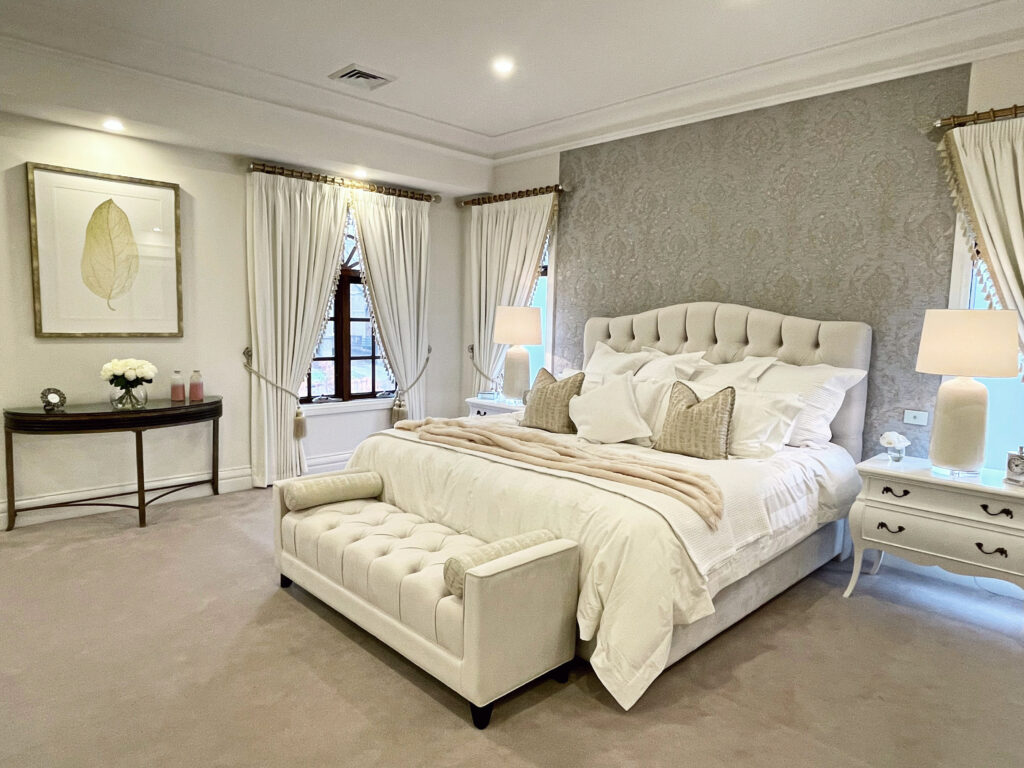
Most bedrooms are not badly decorated. They have a nice bed, reasonable furniture, curtains that more or less work, and walls in a colour that seemed right at the time. And yet they do not feel restful. There is a quality of unease that is difficult to name but immediately felt, a sense that the room is not quite resolved, that something is slightly off without being obviously wrong. This is one of the most common things clients describe when they first speak to us, and it is one of the most rewarding problems to solve, because the causes are almost always specific and the fixes are almost always more considered than they are expensive. The team at Jane Gorman Decorators work with this particular problem regularly, and the patterns in what creates bedroom restlessness are consistent enough to be worth exploring in some depth.
What restlessness in a bedroom actually means
The word restless is worth sitting with for a moment, because it describes something very specific about how a room can feel. A restless bedroom is not an ugly one. It is not a chaotic one, necessarily. It is one in which the eye cannot settle, in which there is no natural place for the attention to come to rest, in which the cumulative effect of all the decisions in the room is stimulating rather than calming. You walk in and you feel slightly on edge without knowing why. You sit on the bed and find yourself looking around the room with a vague sense of dissatisfaction rather than the ease that the room should be producing.
This quality is the opposite of what a bedroom is for. The bedroom is the room in which the transition from the active to the restorative happens, in which the nervous system moves from alertness to rest. A room that works against that transition, that keeps the eye busy and the mind engaged, undermines the purpose of the space regardless of how finished it looks. Understanding what creates that quality of restlessness is the first step towards designing it out.
Too many competing focal points
The most common cause of bedroom restlessness is a room with too many things competing for attention simultaneously. The eye, when it enters a space, is looking for somewhere to land. In a well-designed room it finds that place quickly, settles there, and then moves around the room in a sequence that feels natural and resolved. In a restless room it finds multiple candidates, none of which fully wins, and the result is a kind of low-level visual anxiety that the occupant feels without being able to identify its source.
This tends to happen not through bad decisions but through accumulation. Each individual piece was chosen because it was liked, each artwork hung because it was meaningful, each surface styled because bare surfaces feel unfinished. The result is a room in which everything is present and nothing is primary, where the eye has nowhere to rest because everywhere it looks something else is also asking for attention.
The fix is almost never about removing things that are loved. It is about establishing a clear hierarchy, deciding what the room is actually about visually, and allowing everything else to support that rather than compete with it. In a bedroom, the bed almost always needs to be the primary object, the thing the room is oriented around. When it is not, when the artwork on the opposite wall is as visually demanding as the bedhead, or the curtains are as dominant as the linen, the room loses its centre of gravity and the restlessness follows.
Colour that works against calm
Undertone and its effect on the room
Tonal relationships between surfaces
Furniture that does not belong to each other
One of the quieter sources of bedroom restlessness is furniture that has been assembled rather than composed. Each piece is individually fine but the collection has no internal logic, no sense that the pieces were chosen in relation to each other rather than in response to different moments of need or opportunity. A bed from one era, bedside tables from another, a chest of drawers that was always the wrong scale for the room but has been kept because it functions, and a chair in the corner that was bought for a different room and has never quite settled into this one.
Furniture does not need to match in order to belong together. Rooms with a mix of periods and styles can feel deeply resolved when the pieces share a quality of line or material or proportion that creates a visual conversation between them. What creates restlessness is furniture that does not share any of these qualities, that sits in the same room without relating to it, each piece occupying its own visual territory without contributing to a whole.
The most useful question when assessing bedroom furniture is not whether each piece is attractive in itself but whether the room feels more or less resolved when each piece is in it. Furniture that the room does not need, even furniture that is liked, introduces a note of visual complexity that works against calm. Being willing to remove pieces that are not serving the room is one of the most consistently effective design interventions available, and one of the most psychologically difficult for people to make without an outside perspective.
Lighting that is doing too much or too little
Bedroom lighting is the element most consistently responsible for the gap between how a room looks in daylight and how it feels in the evening, and the evening is when the bedroom most needs to perform. A room that looks reasonable during the day and feels harsh, flat, or vaguely institutional after dark has a lighting problem, and that problem almost always comes down to one of two things: too much undifferentiated overhead light, or not enough light at all, with the resulting reliance on a single lamp that cannot do the work the room requires of it.
The bedroom needs layers of light rather than a single source. Ambient light that fills the room softly without casting harsh shadows. Task lighting at the bedside that is warm and directional enough to read by without illuminating the whole room. And, ideally, a source of accent or decorative light that gives the room a quality of atmosphere in the evening that overhead illumination alone cannot produce. Each of these layers serves a different purpose and the absence of any one of them leaves a gap that the room feels even when the occupant cannot name it.
The bedside lamp question
Overhead lighting and the dimmer
The ceiling and the forgotten surface
The ceiling is the surface that the bedroom occupant spends more time looking at than any other, and the one that receives the least design attention. A ceiling treated as a blank white overhead, with a single central fitting and no further consideration, misses the opportunity to make the room feel more enveloping, more considered, and more restful.
This does not require elaborate treatment. A ceiling painted in a colour that is slightly deeper than the walls creates a sense of enclosure and intimacy that makes the room feel more like a refuge and less like a box. Curtains hung from ceiling height rather than from just above the window bring the eye upward and make the room feel taller and more deliberate. A pendant or chandelier chosen with care for the scale of the room and the quality of the light it casts transforms what is often the most overlooked element of the room into one of its most considered.
Textiles and the absence of warmth
A bedroom that feels cold is almost always a bedroom that is under-textured. Hard surfaces without softness, linen without layering, walls without curtains or a rug without sufficient depth: these are the conditions that produce a room that looks finished in a photograph and feels sparse to inhabit. Textiles are the element most directly responsible for whether a bedroom feels warm and enveloping or correct and slightly empty, and they are the element most often underinvested in relative to their effect.
The bed itself is the most important textile decision in the room. Linen that is layered rather than minimal, with a combination of weights and textures that invites rather than instructs, produces a bed that looks slept in rather than made for display. A throw at the foot of the bed introduces an additional layer of warmth and a note of texture that softens the overall composition. Pillows in varying sizes and covers create depth and visual interest without complexity.
Curtains deserve more consideration than they typically receive. The fabric, the heading, the fall to the floor, the degree to which they exclude light when drawn: all of these decisions influence how the room feels at different times of day. A curtain that hangs beautifully in daylight but allows too much light through in the early morning is a practical failure regardless of its visual quality. One that excludes light effectively but hangs stiffly and without movement is a textural failure that the room feels even when the curtains are open.
The role of the rug
A bedroom without a rug is rarely a bedroom that feels fully resolved. The rug anchors the bed in the room, creates a zone of softness underfoot that is immediately felt at the moments it matters most, and introduces a layer of warmth and texture that no other element quite replicates. It is also the element that, when absent, most often explains the subtle sense of incompleteness that a bedroom can have even when everything else seems to be in order.
Rug sizing is the most common mistake. A rug that is too small for the bed sits awkwardly beneath it, its edges visible in a way that draws attention to the discrepancy between the scale of the rug and the scale of the room. The correct size for most bedrooms allows the rug to extend substantially beyond the sides and foot of the bed, so that the bed is sitting within the rug rather than on the edge of it. This creates a sense of generosity and proportion that a smaller rug cannot achieve regardless of its quality.
The pile height and material of the rug both contribute to how the room feels. A flat-weave rug reads as graphic and considered but offers less underfoot warmth than a deeper pile. A wool or wool-blend rug in a medium pile brings warmth, absorbs sound, and develops a quality of character over time that synthetic alternatives rarely match. In a bedroom, where the rug is encountered barefoot at the most intimate moments of the day, the tactile quality of the material matters as much as its visual one.
Storage and the visible clutter problem
A bedroom that cannot adequately contain the possessions of the people who sleep in it will always feel restless, because the things that have nowhere proper to go become a persistent source of low-level visual noise. Clothes on chairs, shoes without a home, bedside tables covered in objects that would prefer to be in a drawer: these are not housekeeping failures. They are storage design failures, and they cannot be resolved through better habits alone.
The wardrobe is the most important storage decision in a bedroom, and it is one that is too often made on the basis of how the wardrobe looks rather than whether its internal configuration actually serves the household. A beautifully joinery-wrapped wardrobe with an internal layout that does not reflect how the occupant’s wardrobe is actually composed will produce a room full of things that have technically been stored but that do not fit properly, that cannot be accessed without disruption, and that end up migrating back onto the surfaces the wardrobe was supposed to clear.
Bedside storage is the other area that is consistently underplanned. The bedside table needs to accommodate a lamp, a phone, a glass of water, something to read, and often several other objects that accumulate in the intimate zone around the bed. A small, decorative table that looks beautiful but has no surface area and no drawer fails this function entirely, and the objects that cannot be accommodated on it find their way to the floor, the windowsill, or the bed itself.
When the room does not reflect the person in it
There is a subtler form of bedroom restlessness that has less to do with design decisions and more to do with the relationship between the room and the person who inhabits it. A bedroom that feels as though it could belong to anyone, that has no particular quality of personal expression, that is tasteful and correct and entirely neutral, often produces a low level of unease that is difficult to attribute to any specific design failure. The room is fine. It just does not feel like yours.
Personal expression in a bedroom does not mean maximalism or biographical display. It means the presence of a small number of things that are genuinely meaningful, chosen with care rather than as decoration, and allowed to occupy the room with intention. A single piece of artwork that was chosen because it produces something in the person who looks at it. A bedside object that has a particular significance. A material or colour that reflects a genuine preference rather than a safe default. These things are what make a bedroom feel inhabited rather than styled, and it is the sense of being inhabited that most distinguishes a restful room from a merely correct one.
Working with Jane Gorman Decorators on a bedroom
The studio works with clients on bedrooms at every stage, from rooms being designed as part of a broader home project to those being redesigned because they have never felt quite right despite looking finished. The process begins with understanding what quality the client wants the room to have, not the aesthetic category but the actual feeling, the experience of being in the room at the beginning and end of each day.
The most common discovery in that conversation is that the restlessness the client has been living with has a relatively small number of specific causes, each of which can be addressed without redecorating the entire room. A change to the lighting. A rug of the correct scale. The removal of two or three pieces of furniture that the room does not need. A bedhead that gives the bed the visual weight it has been lacking. These are not dramatic interventions, but they are consistently the ones that resolve the quality of unease that sends clients to us in the first place.
If your bedroom looks finished but does not feel restful, we would be glad to help you understand why and what to do about it.
Frequently asked questions
Why does my bedroom feel restless even though it looks fine?
What is the single most effective change I can make to a restless bedroom?
Can a dark colour palette work in a bedroom?
How much should I spend on bedroom textiles?
Do I need to redecorate the whole bedroom to make it feel more restful?
A bedroom that feels restless is not a bedroom that needs to be rebuilt. It is one that needs to be understood. Jane Gorman Decorators works with homeowners to identify what is creating the quality of unease in a room and to make the specific, considered changes that resolve it. If your bedroom has never felt quite right despite looking finished, a conversation with the studio is a good place to start. Get in touch today to discuss your home or book a design consultation.