
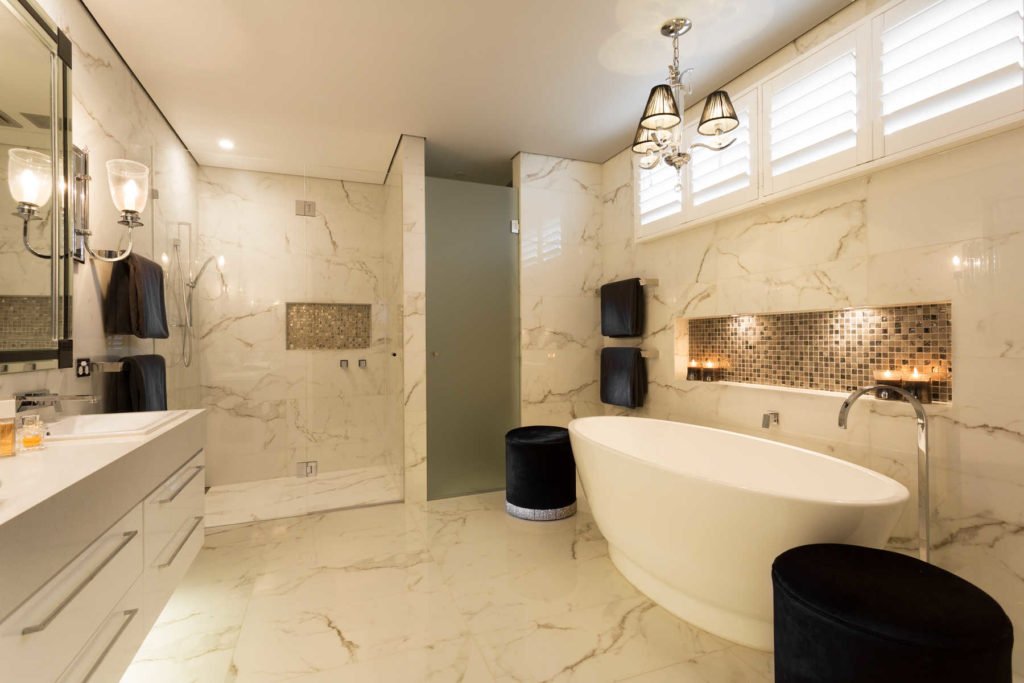
There is a version of luxury bathroom design that looks extraordinary in photographs and feels quietly uncomfortable to actually use. All marble, all white, all hard surfaces and recessed lighting and not a single warm note anywhere. It is the bathroom as architecture rather than as room, impressive from a distance and oddly alienating up close. The homeowners who come to us having renovated once already and found themselves in exactly that situation are more common than you might think. Getting luxury bathroom design in Melbourne genuinely right, not just visually striking but warm, considered, and enjoyable to be in every day, requires a different set of priorities than the ones that produce the bathroom that photographs well and little else.
Why luxury bathrooms so often feel cold
The coldness that afflicts so many high-end bathrooms is not accidental. It is the predictable result of a particular set of design decisions made in pursuit of a particular idea of luxury: the idea that luxury means pristine, that pristine means white and marble and chrome, and that any softness or warmth is somehow at odds with the premium aesthetic being sought.
This idea is understandable. The bathrooms that appear most frequently in the aspirational imagery of interior design publications tend to share certain qualities: pale stone, white cabinetry, cool-toned lighting, minimal styling. They read as luxurious because they are impeccably resolved and immaculately presented. What they rarely communicate is what it actually feels like to be in them at seven in the morning, or on a grey Melbourne winter evening when the last thing you want is a room that feels like a hotel lobby.
The most enduring luxury bathrooms, the ones that still feel deeply right ten years after they were designed, are almost never the coldest ones. They are the ones where the designer understood that warmth and luxury are not opposites, and that the materials and decisions that make a bathroom feel genuinely beautiful to inhabit are different from those that make it look impressive in a photograph.
Warmth as a design intention, not an afterthought
The difference between a bathroom that feels warm and one that does not is rarely a single decision. It is the accumulation of many small ones, each of which either adds or subtracts from the thermal and sensory quality of the room. Warmth in this context is not only about colour temperature, though that matters. It is about the presence of materials that have life in them, light that flatters rather than exposes, surfaces that invite touch, and a level of visual complexity that gives the eye somewhere to rest and something to return to.
A bathroom designed with warmth as a genuine intention from the outset makes different choices at every stage of the process. The stone is selected not only for its visual pattern but for its warmth of tone. The timber element, whether a vanity, a stool, or a shelf, is included because timber is one of the few materials that consistently reads as alive in a bathroom context. The lighting is specified to flatter rather than illuminate, which are related but not identical goals. The styling is not an afterthought added after installation but a considered layer that makes the room feel inhabited.
Stone that has warmth in it
Marble is the default luxury bathroom material, and it is easy to understand why. The movement, the depth, the association with a long history of beautiful interiors: there is a great deal to recommend it. But marble varies enormously in its warmth, and the version most commonly specified in luxury bathrooms, the cool, bright white with grey or blue veining, is also the version most likely to contribute to the coldness that makes so many high-end bathrooms feel unwelcoming.
Warmer stones tell a different story entirely. Travertine, with its caramel and ivory tones and its gently pitted surface, brings a warmth that very few other materials can match and that photographs considerably less dramatically than Calacatta marble while feeling considerably more beautiful to inhabit. Limestone in warm honey or beige tones. Sandstone where the environment allows for its softness. Even marble selected from the warmer end of the spectrum, the creamy, biscuit-toned varieties rather than the cool whites, produces a room with a quite different emotional quality.
The finish of the stone matters as much as the stone itself. A honed or brushed finish absorbs light rather than reflecting it, and the visual effect is softer, richer, and considerably warmer than the high-polished surface that reads as luxury in a showroom and clinical in a bathroom. For floors in particular, a honed finish also has the practical advantage of being less slippery when wet, which is not a negligible consideration.
Timber in the bathroom
The resistance to using timber in bathrooms is understandable but often overcautious. Timber in a wet environment requires appropriate specification and sealing, and there are contexts where it is not the right choice. But in a well-ventilated bathroom with appropriate extraction, a timber vanity, a teak bath mat, a wooden stool beside the bath, or a single shelf in a warm-grained oak can introduce a quality of warmth that no stone or tile can replicate.
Timber reads as organic in a way that other bathroom materials do not. It brings the outside in, in the most literal sense, and its presence in a room full of hard, mineral surfaces creates a contrast that makes both the timber and the stone read more beautifully than either would alone. A bathroom with a natural oak vanity against a warm limestone wall is a quite different experience from the same room fitted with painted cabinetry, even if every other decision remains identical.
The grain direction and the cut of the timber both influence how it reads in the room. A quarter-sawn oak with tight, consistent grain has a quieter, more sophisticated quality than a cathedral-grained board with dramatic movement. Neither is wrong, but the choice should be made in the context of the overall material palette rather than in isolation at a timber merchant.
The role of colour in a luxury bathroom
The instinct in luxury bathroom design is towards neutrality, and neutrality is not wrong. But there is a significant difference between the cool, bleached neutrality of a bathroom designed to look like a five-star hotel and the warm, nuanced neutrality of one designed to feel like a considered private space. The former reads as luxurious at a glance. The latter rewards the time spent in it.
Warm whites, those with yellow, pink, or ochre undertones rather than grey or blue ones, create a visual environment that flatters skin tones, responds beautifully to both natural and artificial light, and reads as genuinely inviting rather than simply clean. These are not colours that announce themselves. They are colours that make everything around them look better, which is precisely what the walls of a bathroom ought to do.
Deeper tones can be extraordinarily effective in a luxury bathroom context. A bathroom painted or tiled in a deep olive, a warm terracotta, a charcoal with brown rather than blue in it, creates an intimacy that is the opposite of clinical and that can feel deeply luxurious when the materials and lighting are working with it rather than against it. The key, as with most colour decisions in bathrooms, is the warmth of the undertone rather than the depth of the colour itself.
Lighting that flatters rather than exposes
Bathroom lighting is one of the most consequential and most consistently underinvested elements of any bathroom renovation, and in a luxury bathroom the gap between good and poor lighting decisions is particularly visible. A bathroom with exceptional stone, beautiful cabinetry, and considered fixtures can still feel cold and unwelcoming if the lighting is harsh, poorly positioned, or tonally incorrect.
The quality most often missing from luxury bathrooms is warmth of light source. Cool, white LED downlights, the default in most bathroom renovations, produce a light that is accurate and efficient and deeply unflattering to both the room and the people in it. The same downlight in a warmer colour temperature, 2700 Kelvin rather than 4000, reads in an entirely different way: softer, more golden, more reminiscent of natural light at its most flattering.
Layering light sources
The dimmer is not optional
Fixtures and fittings: quality over statement
In luxury bathroom design, the temptation is to use fixtures and fittings as statement pieces, choosing the most architecturally dramatic tapware, the most sculptural basin, the most visually distinctive shower head. These choices can work, but they carry a risk that more restrained choices do not: the risk of dating quickly, of reading as a moment rather than a room, of the drama overwhelming the calm that a genuinely good bathroom sustains.
The fixtures and fittings that age best in luxury bathrooms are almost always those chosen for the quality of their material and their proportion rather than for their visual drama. A simple, well-weighted tap in an unlacquered brass or a brushed nickel that develops character over time. A basin that sits correctly in its benchtop rather than demanding to be noticed. A shower head scaled to the shower enclosure rather than to a lifestyle advertisement.
Finish consistency across all fixtures remains one of the most reliable principles in bathroom design at any level. In a luxury bathroom, inconsistency in finish reads not as considered eclecticism but as a lack of resolution, which is the opposite of what the investment is intended to achieve. Choosing one finish and committing to it throughout, or making a deliberate and well-considered case for two, produces a room that feels genuinely resolved.
The freestanding bath and when it earns its place
No element is more associated with luxury bathroom design than the freestanding bath, and few elements are more frequently specified in contexts where they do not genuinely serve the room. A freestanding bath is a significant piece of furniture. It requires space not only for itself but for the space around it, the circulation, the visual breathing room, that allows it to read as an object of beauty rather than something inserted into a room that cannot fully accommodate it.
When a freestanding bath has genuine space around it, positioned under a window or in a room with enough floor area to allow the eye to travel around it completely, it is one of the most beautiful things a bathroom can contain. It creates a focal point, a sense of occasion, a reason for the room to exist beyond pure functionality. When it is squeezed between a wall and a shower screen in a room that needed more thought about its layout before its hero piece was selected, it does none of those things.
The material of the bath itself contributes significantly to whether the room reads as warm or cold. A cast iron bath has a weight and solidity that acrylic cannot replicate, and it retains heat in a way that makes it considerably more pleasurable to use for a long soak. A stone resin bath in a warm tone sits beautifully against natural stone walls. An acrylic bath in a classic form, well positioned and well lit, can be entirely appropriate in the right room. The decision should be made in the context of the whole bathroom rather than from a showroom brochure.
Styling and the lived-in luxury bathroom
The final layer of any luxury bathroom, and the one most responsible for whether it feels like a real room or a display, is the styling. A bathroom without any personal objects, without a plant, a book beside the bath, a considered arrangement of vessels on the vanity, a beautiful soap dish, reads as a hotel room rather than a private space. The luxury that most homeowners are actually seeking is not the impersonal luxury of a five-star hotel but the deeply personal luxury of a space that is beautiful and entirely their own.
This does not mean cluttering the bathroom with objects. It means selecting a small number of things with genuine care and allowing them to occupy the room with intention. A single large-leafed plant in a terracotta pot. Three vessels in complementary tones on the vanity shelf. A linen hand towel folded simply over a rail. A candle in a considered holder on the bath surround. These are not decorating tricks. They are the evidence that the room is inhabited by someone with taste, and that evidence is what makes a beautiful bathroom feel like a luxury home rather than a luxury hotel.
Melbourne homes and the luxury bathroom
Melbourne’s architectural diversity, from the high ceilings and generous proportions of Victorian and Edwardian homes in the inner suburbs to the clean lines of contemporary builds across the eastern and bayside corridors, produces a wide range of bathroom contexts, each of which calls for a different approach to achieving warmth within a luxury brief.
The principal bathroom of a period home in Toorak or Armadale has different opportunities and different constraints from the ensuite of a contemporary home in Brighton or Balwyn. The former often benefits from the architectural generosity of its proportions and responds beautifully to natural stone and classic fixture profiles. The latter may have more considered lighting infrastructure and a cleaner spatial geometry that suits a more restrained material palette. In both cases, the underlying design intention, warmth, quality of material, considered light, human scale, remains the same. Only the specific expression changes.
Working with Jane Gorman Decorators
The studio works with homeowners across Melbourne on bathrooms at every scale, from compact ensuites to principal bathrooms being designed as genuine retreats within the home. The starting point is always the same: understanding what kind of room the client actually wants to spend time in, rather than what category of room they think they should be specifying.
For clients who have renovated before and found themselves with a bathroom that looks impressive but feels cold, the conversation is often about identifying which decisions created that quality and how to make different ones this time. For those approaching a bathroom renovation for the first time, it is about building a brief that captures not only the aesthetic intent but the experiential one, the way the room should feel at different times of day, in different seasons, across years of daily use.
If you are planning a bathroom renovation and want a room that is genuinely luxurious rather than simply expensive, we would love to be part of the conversation.
Frequently asked questions
Why do so many luxury bathrooms feel cold?
What materials make a bathroom feel warm without sacrificing quality?
How important is lighting in a luxury bathroom?
Is a freestanding bath always worth including in a luxury bathroom?
How does Jane Gorman Decorators approach luxury bathroom design?
The most luxurious bathroom is not the one with the most expensive stone or the most dramatic fixture. It is the one that feels like it was designed for the person who uses it, with materials that have genuine warmth and quality, light that flatters and adapts, and a level of personal detail that makes it feel like a private retreat rather than a public statement. Jane Gorman Decorators works with homeowners across Melbourne to create bathrooms that meet that definition. To discuss your project or book a consultation with the studio, get in touch today.